This is Part 4 of a multi-part post.
This post is an attempt to explain how people can be forced to make financial decisions that are not beneficial, why Social Security is necessary, and why the system of medical insurance and private doctors in the United States needs to change.
There are SO many things wrong with what goes on in the U.S. Congress; it is hard to know what to talk about first. I share the feelings of many Americans that the members of Congress are completely out of touch with the people they are supposed to represent. It seems that the majority of members either don't know, or don't care about the hardships most working and retired Americans face every day. The policies they advocate are just plain bad for the average American, and only benefit the very rich and the biggest, richest corporations.
Now that I’ve firmly established that I’m not the brightest light in the sky when it comes to finances, I’m sure some people would say that I don’t deserve any sympathy because of my financial ignorance. In fact, that sounds a lot like what so called “Conservative” politicians are telling the entire country these days. It really seems like they are saying, “Hey, if you aren’t rich, you should just do us a favor and die so we won’t be inconvenienced.”
Now I am a classic reason why we NEED the Social Security system in the U.S.
I’m a relatively bright guy; for example, I earned BA and MA degrees, worked for some of the top technical sector companies in the U.S. and never had a bad performance review, served honorably in the U.S. Air Force, and was number 11 in academics, in a class of 80, during my Air Force Undergraduate Pilot Training, Class 71-08, at Vance AFB, Oklahoma.
However, I have consistently made bad financial decisions. When I worked for Oracle Corporation, I lost money on company stock, when everyone else was making thousands, if not millions. Personal life issues, such as divorces, haven’t helped, because after each divorce, it is like you are starting from zero financially.
Sometimes you are actually starting from a large NEGATIVE number. I really needed a retirement plan where I HAD to put money into the system, it would be managed for me, and paid to me as monthly income, when I reached retirement age. You hear people saying things like, “It isn’t the job of government to protect people from themselves.” and, “I don’t need government acting like my parent.” That may be great for them, but a LOT of Americans do need help managing their retirement savings plans.
The theory behind the current Social Security system is that it is better to be proactive than reactive. In other words, it is better to help workers save for their retirement so they have a reliable monthly income, than to have a large number of destitute elderly people. Of course the current advocates of “Rugged Individualism” would do away with any kind of welfare system too, so the families of the retired poor and religious charities would be the only places the destitute elderly could turn. We all know how little empathy many of the very rich have, and how ruthless the corporations are, so in reality, the elderly poor could expect very little help. It sounds like the “Conservatives” who long for “The good old days” are actually trying to take us back to conditions in England, during the Industrial Revolution. Next thing you know, the Tea Party will be advocating the establishment of Work Houses and Debtor’s Prisons. Yes, I think it really does come down to the Tea Party saying to Americans, “If you aren’t rich, you don’t matter, so just go die and don’t bother us. We have shopping to do on Rodeo Drive.”
I’m sure some adjustments need to be made to ensure to continued financial stability for Social Security, but this system has worked since it was implemented in 1935, and it just doesn’t make sense to scrap something that works.
Setting up some “privatized,” patchwork system of mutual funds and bonds you can buy and sell is just going to make Wall Street richer and leave most working people with very little in their retirement accounts.
I believe that is the whole point of the current attack on the retirement system. The rich aren’t content with the majority of the wealth of the country, they want it ALL, and they don’t want you and me to have ANY. In addition, I think lots of employers would like to reduce the cost of having employees, and see the employer’s share of the Social Security Tax as something they would like to abolish. The freshman class of Representatives seems to be firmly in the pocket of those interested in stealing the little, that working and middle class people still have, to further enrich themselves and their campaign contributors.
Social Security certainly isn’t socialism, because all workers and self-employed people put money into the system. I contributed to the system from 1966 through 2010. I deserve a return on my investment, and I hope you won’t sit quietly in your rocker and let some lying politician steal the hard earned money we contributed to the system.
To be continued …

The life and observations of a retired American teacher living in the Philippines
Sunday, July 31, 2011


Saturday, July 30, 2011
Forced Choices, Part 3
This is Part 3 of a multi-part post.
This post is an attempt to explain how people can be forced to make financial decisions that are not beneficial, why Social Security is necessary, and why the system of medical insurance and private doctors in the United States needs to change.
There are SO many things wrong with what goes on in the U.S. Congress; it is hard to know what to talk about first. I share the feelings of many Americans that the members of Congress are completely out of touch with the people they are supposed to represent. It seems that the majority of members either don't know, or don't care about the hardships most working and retired Americans face every day. The policies they advocate are just plain bad for the average American, and only benefit the very rich and the biggest, richest corporations.
One day, soon after I could withdraw my 401k money without a penalty, I saw an ad on the Internet for what looked like the perfect sailboat for my retirement home. On spring break I drove to Florida with my kids, Adam and Danielle. We took a half-day test sail on the boat. Everything on the boat seemed to work perfectly, and the kids and I had the most enjoyable day together that any of us could remember.
I bought the boat for about $45,000. Since I had inspected everything carefully, and since everything seemed to work correctly, I didn’t see a need to have a Licensed Marine Surveyor inspect the boat. This was a fatal omission, because without a Surveyor’s report, I had no way to establish the condition of the boat at the time I signed the contract with a marina to store the boat. I was planning to moor the boat in Charleston, which is north of most hurricane activity. In Florida, purchased before the start of hurricane season, the boat was effectively uninsurable. Moored in Charleston, I would be able to get insurance that didn’t cost as much as my mortgage payment.
The plan was to leave the Florida Gulf Coast as soon after the end of the school year as possible and with the kids and a couple of their friends as crew, sail around Florida and ride the Gulf Stream north to Charleston. I used the balance of my 401k money to buy about $5,000 worth of charts, electronics, life jackets, a satellite rescue beacon, and a lot of other equipment for the boat.
During this time I was being treated for Prostate Cancer, and the kids needed to take Driver’s Education, so we didn’t make the mid June departure date. Then, my doctor decided my prostate was small enough to treat, so the trip had to be postponed until the next year.
Recovery from the procedure was complicated by a medical equipment failure that sent me to the ER in the middle of the night. The ER Urologist felt he had to lecture me on the folly of choosing a non-FDA approved treatment for 45 minutes before he would treat me. He refused to replace the piece of equipment that had failed, and insisted on inserting a Foley Catheter instead. This slowed my recovery and dramatically compromised my ability to teach for about three months. Because recovering bladder control, after the Foley was removed, took so long, I had to bring two complete changes of clothes to work every day. If I had not had a rest room in my classroom, I would not have been able to work for the first three months of the school year. I started to feel OLD and SICK. I was tired all the time, and this made it more difficult for me to cope when I got difficult students. Feeling OLD, SICK, and TIRED all the time also pushed me toward choosing early retirement.
I had a painful development in my personal life, after my diagnosis in 2007, and I was filling the role of single parent for two teens, and had no spouse or partner to give me emotional support. When I went to Nassau for my treatment, all the other patients had their wives there to help them. I was the only patient who was alone. The emotional toll of the loneliness and sole responsibility for the kids made me emotionally fragile, and I had to go back into therapy in order to deal with the resulting depression.
My health insurance paid for some of the therapy, but there was a considerable out of pocket expense that further undermined my precarious financial situation. I still had to drive 3 hours to see my doctor for follow-up care after my procedure. My Daughter, Danielle, drove me or rode with me to most of these appointments. Some of the time, it was almost like she was the parent, having to take care of me. It was difficult for her to deal with at such a young age, and she had trouble talking to me and expressing her emotions anyway, so I’m sure it was very difficult for her.
When it finally looked like I was going to be able to take the boat to Charleston in the summer of 2010, I hired a Licensed Marine Surveyor to give me recommendations on what should be done to make the boat seaworthy and capable of sailing from the Gulf Coast of Florida to Charleston. His findings were that the boat had been damaged by a tropical storm in August of 2008, and was a total loss. The marina owner failed to properly secure the boat when I had it pulled out of the water, as the storm approached, as was recommended by the marine insurance industry. The boat was blown on its side, there were stress cracks in the fiberglass hull, all six batteries were dumped on top of the engine, spilling acid everywhere, a drain hose broke and dumped thousands of gallons of rain water on the engine and electrical system, and the list of damage went on and on, for seven pages. Given enough time and money, those things could have been repaired or replaced. However, the marina owner was content to collect his $200 a month storage fee, and never told me there was a problem or lifted a finger to help, so the entire interior was covered with mildew and black mold. My clean, neat little ship was a wreck. I had to pay a salvage company $1,500 to scrap the boat so I would not be fined by the Florida and Federal EPAs. It turned out that our wonderful afternoon sail in April of 2008 cost $50,000. I would have been better off paying $5,000 to charter a NEW boat for a week during that Spring Break.
Because I had not had the boat surveyed before I bought it, I had no way to prove the marina owner was lying about the condition of the boat, when I purchased it, so it was inadvisable to take any legal action, since the odds of success were too low.
At this point, I was a complete emotional mess. Twenty years of savings were gone, all the gear I bought was useless without the boat and there was no market for the stuff, 400 miles inland, where I was living. My dream of rocking at anchor off the beach of some tropical island and sailing to foreign ports, which I’d had since age four, was smashed beyond repair. With no insurance the boat would cost more than I paid for it to repair, and I knew that even if I was recalled from my "lay-off" I would not have enough working years to be able to save enough money to replace the boat.
To be continued …
This post is an attempt to explain how people can be forced to make financial decisions that are not beneficial, why Social Security is necessary, and why the system of medical insurance and private doctors in the United States needs to change.
There are SO many things wrong with what goes on in the U.S. Congress; it is hard to know what to talk about first. I share the feelings of many Americans that the members of Congress are completely out of touch with the people they are supposed to represent. It seems that the majority of members either don't know, or don't care about the hardships most working and retired Americans face every day. The policies they advocate are just plain bad for the average American, and only benefit the very rich and the biggest, richest corporations.
One day, soon after I could withdraw my 401k money without a penalty, I saw an ad on the Internet for what looked like the perfect sailboat for my retirement home. On spring break I drove to Florida with my kids, Adam and Danielle. We took a half-day test sail on the boat. Everything on the boat seemed to work perfectly, and the kids and I had the most enjoyable day together that any of us could remember.
 | |
| 1973 Gulfstar 41, Much Ado |
 | ||||||||||
| Newly painted hull with anti-fouling bottom paint |
 | |
Clean and neat as a pin inside |
 | |
| Newly overhauled engine, with batteries and water heater on their shelf in the background |
 |
| My first smile since January, 2007 |
 |
| Adam unfurling the jib |
 |
| Danielle being Danielle |
I bought the boat for about $45,000. Since I had inspected everything carefully, and since everything seemed to work correctly, I didn’t see a need to have a Licensed Marine Surveyor inspect the boat. This was a fatal omission, because without a Surveyor’s report, I had no way to establish the condition of the boat at the time I signed the contract with a marina to store the boat. I was planning to moor the boat in Charleston, which is north of most hurricane activity. In Florida, purchased before the start of hurricane season, the boat was effectively uninsurable. Moored in Charleston, I would be able to get insurance that didn’t cost as much as my mortgage payment.
The plan was to leave the Florida Gulf Coast as soon after the end of the school year as possible and with the kids and a couple of their friends as crew, sail around Florida and ride the Gulf Stream north to Charleston. I used the balance of my 401k money to buy about $5,000 worth of charts, electronics, life jackets, a satellite rescue beacon, and a lot of other equipment for the boat.
During this time I was being treated for Prostate Cancer, and the kids needed to take Driver’s Education, so we didn’t make the mid June departure date. Then, my doctor decided my prostate was small enough to treat, so the trip had to be postponed until the next year.
Recovery from the procedure was complicated by a medical equipment failure that sent me to the ER in the middle of the night. The ER Urologist felt he had to lecture me on the folly of choosing a non-FDA approved treatment for 45 minutes before he would treat me. He refused to replace the piece of equipment that had failed, and insisted on inserting a Foley Catheter instead. This slowed my recovery and dramatically compromised my ability to teach for about three months. Because recovering bladder control, after the Foley was removed, took so long, I had to bring two complete changes of clothes to work every day. If I had not had a rest room in my classroom, I would not have been able to work for the first three months of the school year. I started to feel OLD and SICK. I was tired all the time, and this made it more difficult for me to cope when I got difficult students. Feeling OLD, SICK, and TIRED all the time also pushed me toward choosing early retirement.
I had a painful development in my personal life, after my diagnosis in 2007, and I was filling the role of single parent for two teens, and had no spouse or partner to give me emotional support. When I went to Nassau for my treatment, all the other patients had their wives there to help them. I was the only patient who was alone. The emotional toll of the loneliness and sole responsibility for the kids made me emotionally fragile, and I had to go back into therapy in order to deal with the resulting depression.
My health insurance paid for some of the therapy, but there was a considerable out of pocket expense that further undermined my precarious financial situation. I still had to drive 3 hours to see my doctor for follow-up care after my procedure. My Daughter, Danielle, drove me or rode with me to most of these appointments. Some of the time, it was almost like she was the parent, having to take care of me. It was difficult for her to deal with at such a young age, and she had trouble talking to me and expressing her emotions anyway, so I’m sure it was very difficult for her.
When it finally looked like I was going to be able to take the boat to Charleston in the summer of 2010, I hired a Licensed Marine Surveyor to give me recommendations on what should be done to make the boat seaworthy and capable of sailing from the Gulf Coast of Florida to Charleston. His findings were that the boat had been damaged by a tropical storm in August of 2008, and was a total loss. The marina owner failed to properly secure the boat when I had it pulled out of the water, as the storm approached, as was recommended by the marine insurance industry. The boat was blown on its side, there were stress cracks in the fiberglass hull, all six batteries were dumped on top of the engine, spilling acid everywhere, a drain hose broke and dumped thousands of gallons of rain water on the engine and electrical system, and the list of damage went on and on, for seven pages. Given enough time and money, those things could have been repaired or replaced. However, the marina owner was content to collect his $200 a month storage fee, and never told me there was a problem or lifted a finger to help, so the entire interior was covered with mildew and black mold. My clean, neat little ship was a wreck. I had to pay a salvage company $1,500 to scrap the boat so I would not be fined by the Florida and Federal EPAs. It turned out that our wonderful afternoon sail in April of 2008 cost $50,000. I would have been better off paying $5,000 to charter a NEW boat for a week during that Spring Break.
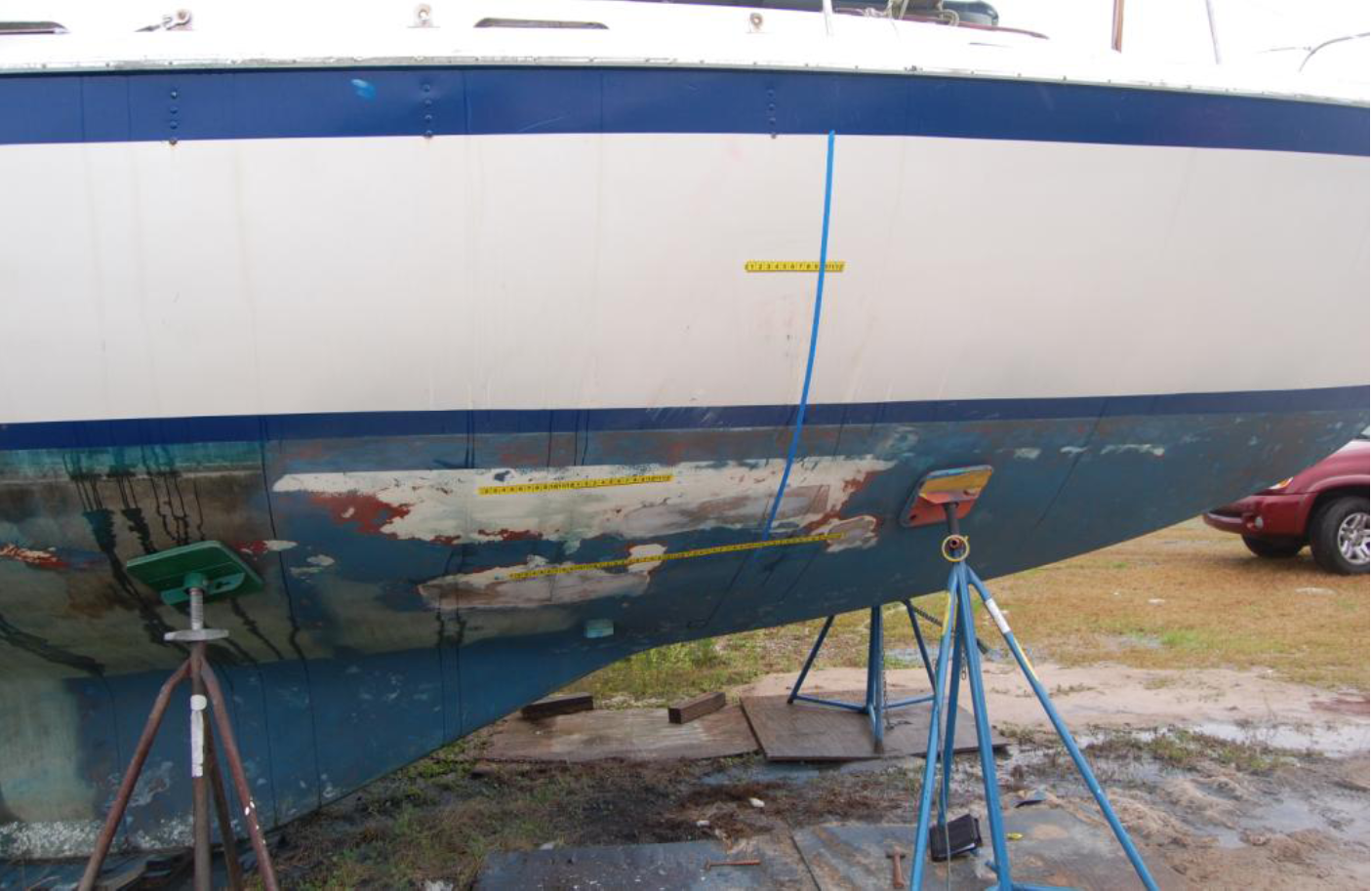 |
| Just one example of stress cracks in the hull |
 |
| Mildew everywhere |
 |
| All my stuff thrown everywhere and more mildew everywhere |
 |
| Engine with batteries and water heater dumped on top. Not visible is the toxic soup of diesel engine oil, battery acid, and rain water underneath, and filling the bilge from stem to stern. |
Because I had not had the boat surveyed before I bought it, I had no way to prove the marina owner was lying about the condition of the boat, when I purchased it, so it was inadvisable to take any legal action, since the odds of success were too low.
At this point, I was a complete emotional mess. Twenty years of savings were gone, all the gear I bought was useless without the boat and there was no market for the stuff, 400 miles inland, where I was living. My dream of rocking at anchor off the beach of some tropical island and sailing to foreign ports, which I’d had since age four, was smashed beyond repair. With no insurance the boat would cost more than I paid for it to repair, and I knew that even if I was recalled from my "lay-off" I would not have enough working years to be able to save enough money to replace the boat.
To be continued …
Forced Choices, Part 2
This is Part 2 of a multi-part post.
This post is an attempt to explain how people can be forced to make financial decisions that are not beneficial, why Social Security is necessary, and why the system of medical insurance and private doctors in the United States needs to change.
There are SO many things wrong with what goes on in the U.S. Congress; it is hard to know what to talk about first. I share the feelings of many Americans that the members of Congress are completely out of touch with the people they are supposed to represent. It seems that the majority of members either don't know, or don't care about the hardships most working and retired Americans face every day. The policies they advocate are just plain bad for the average American, and only benefit the very rich and the biggest, richest corporations.
When I worked in the computer industry, I put as much money as I thought I could afford in 401k plans. The money I put in the 401k was to buy a sailboat, which would be my retirement home, and on which, I would cruise the world. When I was laid off in January 2007, I had about $50,000 in my 401k.
Otherwise, I was a good little American consumer, and spent everything I earned. Some of that was a rebellion against my "Children of the Depression" parents' extreme thriftiness, and some was the blind confidence in my ability to always find a good job. Throughout my working years, if a company closed or a job became problematic for me, I was always able to find not just a better paying job, but a MUCH better paying job. I had a skill set that was in demand, and good performance evaluations from all my managers. I just didn't see a need to save for the proverbial "rainy day" because I thought my skills and references would always be my umbrella.
I talked about not being able to find work in the computer industry in Part 1 of this post. Here are some reasons why. First, my primary skill set, as a UNIX System Administrator, was based on the products of one hardware manufacturer. In July 1999, IBM bought out Sequent Computer Systems to acquire patents for Non-Uniform Memory Access technology. They killed the Sequent product line, and the DYNIX version of UNIX that was their operating system, in favor of their own AIX version of UNIX. By 2007, my skill set was obsolete, and no longer in demand. I had been lazy and complacent, and hadn't earned certifications for other systems or versions of UNIX because all the MAJOR companies, like CISCO, ORACLE, and BOEING were using Sequent hardware, so I felt very secure as a Sequent "expert." These factors, along with my age, years of experience, and pay history, made it impossible for me to find work in the computer industry in 2007. The tech sector was already slipping into the recession that would wreak havoc on the rest of the economy in 2008.
I had always worked, mowing lawns and shoveling snow as a kid, and for an employer, since I was 16, and so I used my fall back skill, my teaching degrees, rather than sit collecting unemployment, and deluding myself that I would find a computer job.
In a misguided attempt to "make a difference," I took a job teaching children who had been expelled from their home school for serious violations of district rules. At first, it seemed like a dream job. I had one fourth grade student who brought a weapon to school because he was afraid of bullies. He was a nice kid, and we got a lot of schoolwork done, while I tried to help him build up his self-confidence, problem solving, and decision-making skills.
When a fifth grader was added later in the year, it actually helped accelerate the learning process. The fifth grader was also a "nice kid." He brought a weapon to school to show off. He wanted attention because his mom was giving most of her attention to a new boyfriend. The little guy got a lot more attention than he bargained for. He was a curious kid, and fit right in with my way of running the class, because I always tried to use what a student was interested in as the introduction to the research skills and academic work they needed to learn about their interests. It took a lot of extra work in my lesson plans to show the principal how studying, honey bees, for example, fit in with the "standard course of study," but I thought it was worth the effort.
Both of these students did well, by my evaluations, but did not show that progress on their standardized tests. The fourth grader returned to regular school, and successfully stayed out of trouble for at least the next two years. The fifth grader went back to regular school and was selected as "Student of the Month," his first month back in regular classes. Later, he was back in an "Alternative" program. I suspect the birth of a little brother caused a need for attention, and our work on better ways of getting attention hadn't jelled as well with him as I had thought. However, all in all, I was feeling like a successful teacher, and was very happy with my job.
The next school year, I got some hard core gang members who had been retained numerous times, and who were taller and bigger than I was, a crack baby grown into a teacher's nightmare, and a seriously emotionally troubled kid who was assigned to the program because he physically assaulted the security officer at his home school. At one point, I had 11 powder keg kids in my classroom. The year was not a good one for me. My low key approach didn't work with these kids. They weren't interested in anything except gang stuff, criminal activity, weapons, and gangster music. Because I couldn't find a key to unlock their curiosity, I had no leverage to direct them into learning. I was at a complete loss, so I just used End of Course Test preparation workbooks, and marked time, praying for the end of the year. When the four foot tall crack baby threw a 70 pound desk across the room at me, and left a foot deep dent in a steel cabinet, I was at an all time professional and emotional low point. This was probably the moment that was most responsible for my decision to retire as soon after I was 62 as possible.
There is always a process that leads a person to a given decision. For me, the process started with my dad, who retired at 62. He saved a LOT of money over his working years, and had the benefit of a civil service pension, so that between his pension and his Social Security, he didn't take a pay cut when he retired. I wasn't in as sound a position, but I remembered when he told me that the extra money he would get from working until he was 65 was not worth the stress he was getting in his job. A new City Manager was making his life miserable. As City Treasurer, he was appointed, by the pleasure of the City Council, so he felt like his job wasn't secure for the first time in 30 years. I did some preliminary math, and decided that working until I was 66 was not worth the stress I had in my job, just to qualify for teacher's retirement. I would get less than $500 a month additional income because I would only have five or six years of service.
My choice to retire at 62 wasn’t forced, except in the sense that the failing U.S. Economy and the side effects of bad legislation left me with no good options for earning a living. Perhaps if I could have worked in Special Education, in my specialty of Learning Disabilities, I would still be teaching now, getting paid at Master’s level, and I’d still be making mortgage payments on a house. There is no way to know.
To be continued …
Friday, July 29, 2011
Forced Choices
This is Part 1 of a multi-part post.
I have not been posting for a while, but I'm in the process of trying to increase readership of my blog, and hopefully, get my ideas out to more people than just my friends. This is an attempt to explain how people can be forced to make financial decisions that are not beneficial, why Social Security is necessary, and why the system of medical insurance and private doctors in the United States needs to change.
There are SO many things wrong with what goes on in the U.S. Congress, it is hard to know what to talk about first. I share the feelings of many Americans, that the members of Congress are completely out of touch with the people they are supposed to represent. It seems that the majority of members either don't know, or don't care about the hardships most working and retired Americans face every day. The policies they advocate are just plain bad for the average American, and only benefit the very rich and the biggest, richest corporations.
When I retired at age 62, I made some forced choices. First, I chose to move to the Philippines so that my income would go further due to the lower cost of living. Second, I chose to pay for health care in cash, as needed, rather than pay for health insurance. Many Americans living in the Philippines do this, and due to the lower cost of hospital and physician services, it is not as crazy as it sounds, but it can be very stressful, when you have known health issues. Now because I have a "break in coverage," I can't get health insurance that doesn't exclude my "pre-existing conditions," forever. Now the members of Congress would say that problem is my fault because I made bad choices. However, there are many circumstances that forced me to make those choices.
The policies that made outsourcing or setting up tech support call centers in India and Brazil made me expendable to my employer, and I was laid off from a $100,000 + a year job in January 2007. The tech sector economy was already sliding into the great recession, so it was impossible for a 58 year old, with nearly 20 years experience with major tech companies, to find a job. I worked as a substitute teacher, while applying for a current teaching license, barely paying the bills, and paying for COBRA from my severance pay. I was never able to get even a doctor's visit paid for through the COBRA "coverage" and when the severance money ran out, I couldn't pay the ridiculously high premium, so the "coverage" lapsed.
I had to turn in two of the three cars I was buying, to the banks that held the loans. Now these banks treated me just the same as if they had to send the repo man to get the cars in the middle of the night, and then sold the cars for very low prices, and told me I owed them the difference between the loan balance and what the cars brought at auction; about $13,000 and $11,000, respectively. I continued to make my mortgage payments from my savings.
Because of the so called, "No Child Left Behind" legislation, which, by the way, only benefits the testing company mandated to establish qualifications, I found that my Master's Degree was completely irrelevant to the certification agency, because I hadn't taken the prescribed test. I had taken a test that was acceptable to establish my competence as an Elementary School Teacher, but only at the Bachelor's level. As a result, I could not be hired in my primary skill and experience area, with the most job opportunities. I had to apply for jobs in Elementary Education, with the least available jobs, and the most competition. I was eventually hired in January, 2008, at less than 1/3 the salary I had been making. The main reason I took the job was that I got health insurance. My pay covered groceries and utilities. I still had to pay my mortgage and car payments from my savings.
I was diagnosed with Prostate Cancer in July 2007. I went on hormone suppression therapy to shrink the gland to a treatable size. I had to drive for 3 hours, every month, to get to the doctor's office for my treatment. They injected a slow dissolving "pill" under the skin of my thigh, which suppressed my testosterone production, because testosterone is like fertilizer for Prostate Cancer. Having lots of estrogen and very little testosterone in my system let me experience the joys of menopause, first hand. I went through hot flashes, which are nothing to joke about, guys. I thought I was losing my mind, because I would start crying for no reason. In July, 2008, my prostate was down to maximum treatable size. I had to fly to Nassau, Bahamas for treatment, because the FDA had not, and still has not, approved High Intensity Focused Ultrasound treatment. All of this treatment was entirely at my expense because the of the FDA approval status. After 5 1/2 hours of treatment, my cancer was completely killed, and I have been cancer free since then.
To be continued...
Sunday, February 20, 2011
Why we can't all get along...
Good people often ask, "Why can't we all just get along?" There are four main reasons that, as the world exists today, it is impossible for us to get along unless we make some changes.
Reason 1:
The animal part of the brain is in charge a surprising percentage of the time, and the animal brain does not like anything or anyone different. There is a well known Biology experiment where you take a group of chicks that hatch at the same time, and when they are about a week old, you use food coloring to dye one of them red, one green, and one blue. The little yellow chicks are soon pecking the dyed chicks to the point of injury. There seems to be a template in the brain based on the faces a child grows up with, and a face that doesn't roughly fit in the template brings feelings of uneasiness and distrust. Kids who grow up going to day care in the San Francisco area seem to be exposed to enough different faces that all the kids seem to get along. If you introduce a kid with a different skin color or ethnic facial features into a remote rural area where kids have only seen their immediate family members faces, there are usually bad reactions.
Reason 2:
Parents usually feel a need to pass on their political beliefs; biases and prejudices; religious beliefs; and life philosophy to their children. This is highly successful most of the time. As a result, we have two factions of Islam still hating each other over who should have succeed Muhammad ibn ‘Abdullāh as leader of the religion when he died in 632 CE. We have many different groups of Christians who disagree about even basic principles. We have several different groups of Jews so polarized it is difficult to believe they are part of the same religion. We have tribes who hate each other because one took slaves after winning a battle 300 years ago, and so on and on and on. Too many grudges to count. We even have families who hate each other over something great great great grandpa Wilber did in 1792. The European colonization movement provided the conditions for people in the colony to hate a whole country. Various missionaries, believing they were doing the will of their god, perpetrated terrible atrocities on indigenous peoples in misguided efforts to "save" and "civilize" the heathen savage. The North American colonists and later, the United States government wiped out many cultures and languages, not to mention whole tribes of people. Now most of that would just be inconvenient if it weren't for one thing: each group believes they have the one and only truth that came direct from the hand or spoken word of their GOD, him or herself. Christians point to a passage in their book, that according to the circular logic they are so fond of, PROVES that they have the one and only exclusive truth. Combine that with being passed from parent to child, the strength and irrationality of their beliefs, and the conviction that everyone else is WRONG, and you have a downright dangerous situation. Because of this, only a few learned and brilliant scholars can discuss religious thought with members of different religions rather than argue or fight. I always wanted my children to decide for themselves what they believed because I've never been sure about anything, except that it is wrong to treat other people badly. Giving your children that freedom is a little uncomfortable, but I believe parents need to stop teaching after we communicate some basic ethical principles. Until people are able to look at religious, philosophical, and political issues objectively and discuss calmly; allowing themselves to recognize the possibility that another person may have a worthwhile point, rather than feeling a need to prove them wrong, we will always have the seeds of violence between people on the earth.
Reason 3:
My father told me that human greed was the single most dangerous emotion. He said that without greed, con games wouldn't work, people would not gamble away their savings, and there would be no reason for war. Someone always profits from war. Starting with the flint knappers, the people who supply the weapons profit from war. They always find ways to exploit Reasons 1 and 2 so that everyone else, who has everything to lose, will fight in their wars. Kings waged war to expand their territory, and thus increase their income by having more people to tax. In Shakespeare's play, "Henry V," Prince Hal has led a wild, drunken life and so the people didn't expect much from him. His father doesn't know Henry's true capabilities, so on his death bed he advises, "Have a foreign war." The father's advice was based on the idea that having a foreign enemy would bring the people together behind their new king. I can definitely visualize GHWB, or George I, advising GWB, or George II to have a foreign war.
Reason 4:
People are lazy, especially intellectually. Most people don't want to think for themselves. They want the Preacher or Rabbi or Iman to tell them what to believe. They read their holy book, but don't bother to get the education needed to properly interpret what they read or put it in context. Historians copy from older historians without bothering to research whether the old historian knew what he was talking about. For centuries, people were content with Aristotle as THE authority on everything. Sadly, Aristotle just pulled things out of the air and never did a real experiment. Because people are mentally lazy, they are easy to manipulate. So much is known about the psychology of selling and advertising that it is a simple matter to convince a whole country that WMD are an imminent threat, when in fact, no Weapons of Mass Destruction existed. I see evidence of mental laziness in politics today because rather than present data, politicians (and lots of citizens) just call someone a "liberal" as if that is a dirty word, and that name calling alone is sufficient to make a case or prove a point. There is little meaningful discussion or debate in U.S. politics today, and so elections have become popularity contests. Most politicians today don't do any work to learn how to run government more efficiently and how to work for the good of the people. Combine that with the greed of politicians who allow themselves to be bought by corporations and special interests, and you have the mess the U.S. Government is in today.
Now how can we get ourselves out of this mess? Well, it would take good old fashioned work. First, people who really want to fix things need to organize, find and train candidates who are completely committed to honest government, for the people and by the people. Second, they need to work to get those candidates elected. The Presidency is really not as important as the Congress in putting together a working reform movement. If you have a majority in Congress, you can do a lot whether or not the President agrees. If you have a big enough majority, you can override the Presidential veto, and pass legislation in spite of Presidential opposition. It certainly would be a lot safer to make changes this way than to take to the streets in a Twitter uprising. I don't think the corporations who have the real power now would hesitate to use deadly force on even a million protestors, and I'd hate to think what military weapons would do to massed or marching protestors. The question is, do we have any people honest enough and hard working enough to make real change possible? Can we stop bickering over ideology long enough to actually get something done? What do you think?
Friday, February 18, 2011
Randomness
I am always amazed at the total lack of discipline in people here both as drivers and as pedestrians. I am constantly reminded of the wonder on the paleontologist's face when the herds of dinosaurs in the movie, "Jurassic Park" wheeled and swirled like flocks of birds. This is exactly how people here move. I don't think anyone is even capable of walking in a straight line. The stop for no reason, move in different directions without looking, don't ever seem to look where they are going, and walk straight at you and expect you to get out of their way. They are totally oblivious to what the packages they are carrying are doing. On the MRT the other day, a lady was fanning herself with a fan woven from palm fronds and on a fairly stout stick handle. Every other swish, it was whack on my left shoulder, pause, whack, pause, whack. I squeezed Grace's hand a little harder than I intended, and tried to remain serene. When driving, people who own their cars seem almost sane, but the traffic mix is insane here. There are pedal powered bikes with metal side cars welded to them, pedal powered cabs, push carts, motor powered tricycles, totally under powere scooters, taxis, jeepneys and all sizes of buses trying to use streets that are too narrow for the traffic volume, all at the same time. The tricycles, both human and motor powered, pull out in front of anything, always seemingly without looking, and the vehicle that should have the right of way has to slam on the brakes. Speaking of "right of way,' it seems to be law of the jungle, and who ever cares least about getting hit and is most aggressive TAKES the right of way. This is the ONLY place I've ever been, where people drive on the right side of the road, where people turning left think THEY have the right of way. This total lack of self discipline is to blame for a lot of the traffic chaos here. Taxis and tricycles and buses win NOT pick a lane and stay in it. They are constantly trying to jockey for a few feet advantage. I've said before that people here are only really happy if they are driving in two lanes simultaneously, and it is totally true! This applies to walking too. It seems that some people feel their mission in life is to get in front of the person ahead of them. If they are fast walkers I don't mind that, but when the get in front of me, 90% of the time they slow down to a crawl. It is impossible for us to walk together holding hands, most of the time, because people walk straight toward our hands and expect us to clear the way for them. The streets are so wide some places that it is impossible to cross them. There are lots of pedestrian bridges, but it is very difficult to use them because the steps climb at a very steep angle, and because of all the pushing and shoving from other people. Most of the time, the steps and walk ways are steel, and when it rains, they are VERY slick. The other day, I bought a small slow cooker. By the way, I'm cooking beef stew and it is almost ready. It smells very good. When I was bringing it home, the MRT security guard decided I must be a terrorist, smuggling a bomb in my Rustan's shopping bag, with my Rustan's receipt on top of the slow cooker box, so I had to not only take the box out of the bag, but take the slow cooker AND every bit of packing out of the box so he could visually inspect and make sure I hadn't hidden some C4 in the bottom. Grace doesn't like beards, but does like stubble, so I also had a new Braun cruZer in the shopping bag so I can keep a uniform stubble look. Grace says it makes me look like a bad boy. Now that all of you who have know me forever are done rolling on the floor laughing at the idea of ME being a bad boy, I'll get to the point of the story, which was that I was afraid he would make me open that and have to inspect all of the small combs and parts that come with it. Mercifully, he didn't, but the whole slow cooker inspection took a terribly long time. Usually, security guards don't check me carefully because they think Americans are not a threat. Maybe it was my "bad boy" stubble that made him visually profile me. There are security inspections at the entrance to every mall and public transportation terminal. Not that long ago, a package in the luggage locker of a long distance bus exploded and killed several people, so there is an actual need for security checks here. There is a different line for men and women for inspection, and Grace didn't see what was happening, so she was already out of sight when Mr. Efficient got done with me. I felt like the three year old who got too brave and now can't see mom. In our business, people frequently hang up when I answer the phone, I guess they are afraid they will get a terminal nose bleed if they hear more than two words of English. (That's what native Tagalog speakers say about talking to me...I give them a nose bleed. It means that the mental work of thinking and speaking in English is too much work.) Grace usually answers my phone, and had it in her bag, so I didn't have a way to get in touch with her. I didn't know whether to just stand there and wait or to go down to the platform and hope I could find her. Fortunately, she came looking for me before I had to sit down and start crying. I THINK I could have made it home by myself, but it probably would have involved finding a taxi, and have been more expensive. I need to remember to keep a phone on me when we are out!
Saturday, February 12, 2011
About My Pre-Retirement Life...
Some of you have known me forever, and some of the people I think are significant in my life have been out of touch for a while, so this is a brief autobiographical sketch.
School and Work:
After graduating from Theodore Roosevelt High School in Des Moines, Iowa in 1966, I attended Grinnell College and graduated with a BA in History in 1970. I attended U.S. Air Force Pilot Training at Vance AFB, Enid, Oklahoma but did not graduate, and was assigned to Navigator Training at Mather AFB, just outside Sacramento, CA. I graduated and went on to Navigator Bombardier training, eventually becoming a navigator on B-52D aircraft at Dyess AFB, Abilene, Texas. I did 2 TDY tours to Anderson AFB, Guam and flew 3 combat missions at the end of the Vietnam war. I resigned my commission in 1975 and went back to school at Hardin-Simmons University in Abilene, to get my teaching certificate. I worked as a janitor at St. Paul United Methodist Church in Abilene while I was attending classes. I taught one semester in the Abilene, Texas Public Schools in 1978 as a Special Education teacher at Jefferson Jr. High. I worked nights at Jack-in-the-Box, and the third time they asked if I wanted to be an Asst. Manager, I asked how much it would pay. It was twice what I made teaching, so I went to work for Jack. I was transferred to Albuquerque, NM to help open a new store in 1979. In 1980, my store manager told me he was really an alien from another galaxy, and he was totally serious. I found out there was a teaching vacancy at Taylor Middle School, and the next day I was teaching again. I taught several Special Ed. programs at Taylor until the new Lincoln Middle School opened in Rio Rancho. At that time, Rio Rancho was part of the Albuquerque school system, so I transferred to Lincoln. I taught there until November of 1987, when I took a full time position with the New Mexico Air National Guard. Before that time I had been a weekend warrior, working in Personnel and as Budget Officer. My new position was Commander of the Mission Support Flight. In 1989, my good friend, Don Wetzel, got me an interview with GTE Educational Network Services in the Dallas, Texas area, and I was offered a job answering their customer support line. A year later, ENS upgraded their main computer system to a reconditioned Sequent S-81, and my boss told me, "George, you are good at making things work, so you are our new UNIX system administrator." After looking up UNIX to make sure it didn't involve amputation of any body parts, I accepted the job, and ENS paid for a number of classes at the Sequent factory in Beaverton, Oregon. I am proud of the work I did for ENS because I ran hardware that was both a production and development system simultaneously. In 1994, the parent GTE company decided to close ENS, just as we were on track to be profitable in 1995. I interviewed with Oracle Corporation, and took over as the Sequent System Administrator. The position had been vacant for over a year, so there was quite a backlog of work, but I was single and didn't mind long days or working all night, so I got the backlog cleared in about three months and reduced configuration request response time from 2 weeks to 24 hours or less. I got a programmer's bonus share that quarter, and bought a 23 foot Santana sailboat, which I sailed on San Francisco Bay from the Coyote Point Marina. In 1999 I went to work for West Interactive in Omaha, Nebraska, mainly because the cost of living in California was so outrageous. In addition, IBM bought Sequent to get their patents to Non Uniform Memory Access or NUMAQ technology, and I realized that my time at Oracle would be limited when IBM killed the Sequent product line. I did a lot of the pre Y2K UNIX work for Oracle, and wrote a lot of the policies, so West hired me to make sure their preparations were adequate. West fired me shortly after Y2K came and went without an issue. I worked for First Data in Omaha, and then got a call asking me what it would take to bring me to Charlotte, North Carolina. It seems Electronic Data Systems (EDS) had a major client running Sequent hardware. I gave what I thought was an outrageous figure, and 2 weeks later I was driving a U-Haul to Charlotte. I worked for EDS from October 2001 until I was laid off in January 2007. The client bought Sun systems, and it was much cheaper for EDS to hire someone in India or Brazil than to pay me, even though I was fully qualified on Sun systems. I briefly worked as a consultant for Wachovia Bank, but apparently the manager who put in the request had moved on, and no one could find anything for me to do, so at the end of 3 months, my contract ended. I was not able to find any UNIX SA work, so I did substitute teaching in the Cabarrus County, North Carolina schools while I worked to qualify for a North Carolina license. In 2008 I was hired to teach any elementary students assigned to a school for kids expelled from their home school, usually for some criminal act or serious violation of district rules, like bringing a gun to school, in the Charlotte school system. I had one 4th grader to start with, and taught him on the stage of the multipurpose room. The next year I had my own room and as many as 11 kids, all 6th graders, in my class. When I reached 62, I was ready to retire, and have never regretted that decision.
Significant Relationships:
I married Kathleen Cory Avise in May, 1969. We were friends in High School, and our youth minister's wife pushed us at each other Christmas vacation 1968. We had two birth sons, Kristofer Kane Avise-Rouse, in December 1969 and Kelly Kyle Avise-Rouse in January 1971. We adopted two children, Kymethe Kory, and Kenneth Kevin. Kate and I were primarily casualties of the Vietnam war, and divorced in 1977-78. Kate passed away in 2005. I married Earlene Louise Maharg in June 1978. We had one son, Jason Martin Wolfe in November 1984. We divorced in 1988. I married Gwen Marie Helm in June 1996. She already had 3 great kids, Tansy Marie Wolfe Perlman (Tansy changed her last name to mine the day after her 18th birthday, so I must have been an OK step-father), Adam Michael Wait, and Danielle Brooke Wait Leffler. Gwen and I divorced in 2008. I married Mary Grace De la Torre on November 30, 2010 at Paranaque City Hall in the Philippines.
Health Issues:
I kept getting sick and the doctors couldn't figure out what was wrong. I had my left kidney removed because they were sure a growth on the main artery was renal cell carcinoma, but it turned out to be benign. I had my gall bladder removed. Nothing helped. Finally, I got so sick they were able to diagnose the problem, acute pancreatitis. I was on no food for a week, and then took 8 pills before every meal for 2 years. I changed to a low fat diet, and have been fine ever since.
I was diagnosed with Prostate Cancer in 2007, which, by the way, was a terrible year for me. I was on hormone suppression therapy for a year to get the prostate down to treatable size. That was a TRIP! I got to experience the joys of menopause first hand. Guys, don't ever joke about hot flashes. They are NOT fun. Neither is wanting to cry when there is really no reason, and wondering if you are going crazy. Then I flew to Nassau, Bahamas for High Intensity Focused Ultra Sound treatment. Basically it microwaves the prostate 2mm at a time. Fortunately, I was asleep for the 5 1/2 hour process. I chose this treatment because it is least likely to have undesirable side effects, and since I met Grace, I have been VERY glad I made that choice. I have been cancer free, according to my quarterly blood tests, since July 2008, and had that confirmed with a 12 needle biopsy in September of 2010, here in the Philippines.
So now you are pretty much up to date with the "Long and Winding Road" that led me to the Philippines.
Subscribe to:
Posts (Atom)